A Keyword Match Isn't a Buying Signal: How Intent Scoring Works
A keyword tool tells you a word appeared. It says nothing about whether the person is ready to buy. Here is how intent scoring closes that gap.
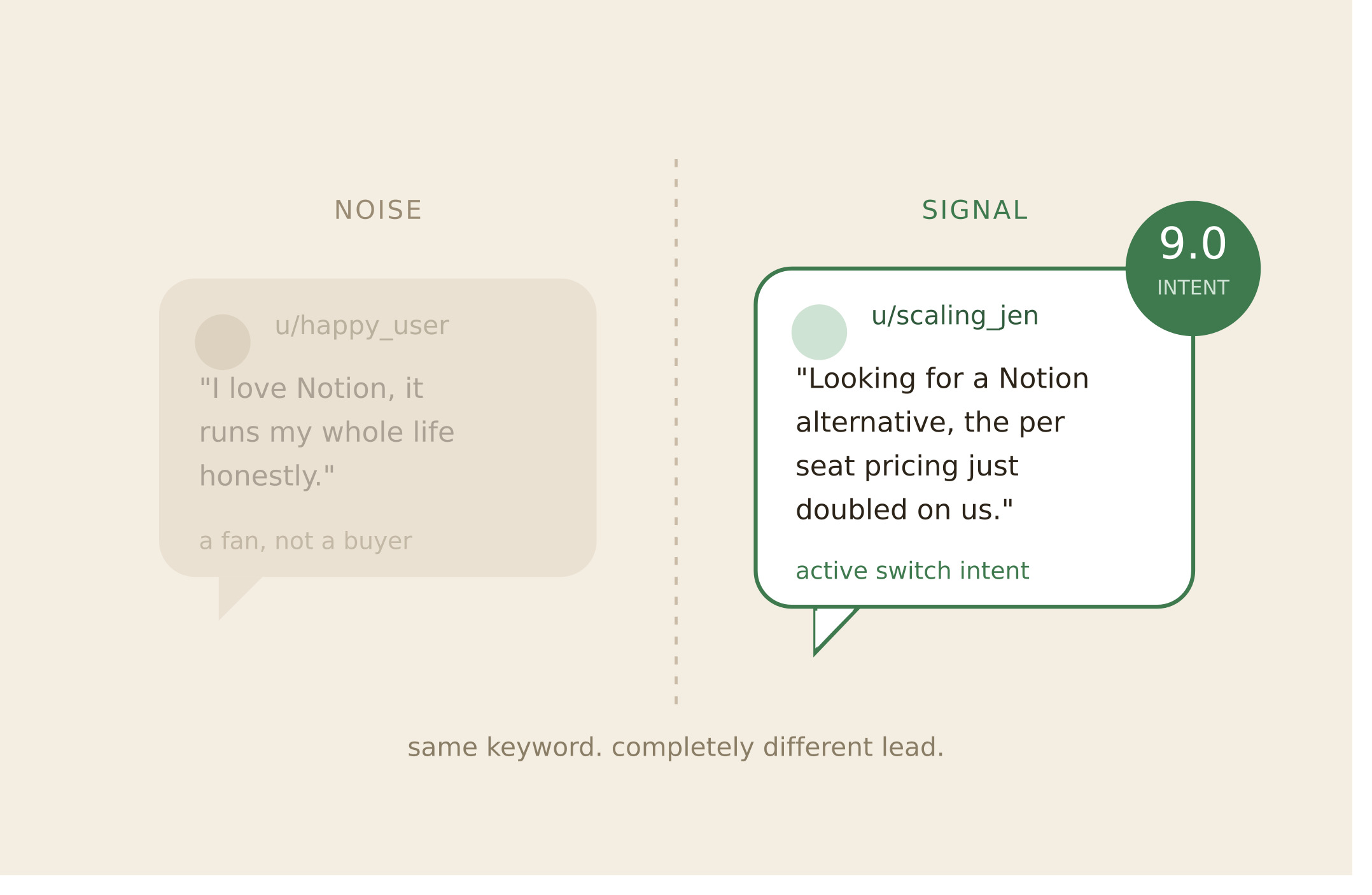
Here are two posts. "I love Notion, it runs my whole life." And "Looking for a Notion alternative, the per seat pricing just doubled on us."
A keyword tool treats these the same. Both contain the word Notion, so both get flagged. But only one of them is a person you actually want to talk to. The first is a fan. The second is a buyer.
This is the core weakness of keyword monitoring. It tells you a word appeared. It tells you nothing about whether the person saying it is ready to make a decision. Intent scoring exists to close that gap.
The idea is to read each conversation across a few different dimensions and combine them into a single score, so that what reaches you is filtered by readiness rather than just relevance. Four signals do most of the heavy lifting.
The four signals
The first is language. Direct phrases like "recommend," "looking for," or "anyone using" carry far more weight than a neutral mention. The way someone phrases a post tells you whether they are venting, praising, or actively shopping.
The second is recency. A thread posted an hour ago where someone is asking right now is worth more than one that has been sitting quietly for a week. Intent decays. A good score reflects that and gives fresh conversations the bump they deserve.
The third is fit. A buying signal from someone who matches your ideal customer matters more than the same signal from someone who never will. Team size, role, and company stage all shape how much a conversation is worth pursuing.
The fourth is competitor signal. When someone names a specific tool they are unhappy with, or asks directly for an alternative to it, that is one of the strongest signals there is. They have a budget, a use case, and a reason to switch.
From a list to a ranking
Score those four together and the picture changes completely. Instead of a flat list of every mention, you get a ranking. The conversations worth showing up for rise to the top, and the noise quietly falls away.
The real benefit is not just saved time, though that is part of it. It is that your attention goes to the few people who are genuinely ready to hear from you, which is better for them and better for you. A keyword match starts a search. An intent score ends one.