I Manually Searched Reddit for Leads for a Year. Here's What I Learned.
Your buyers are already asking for what you sell. After a year of finding those threads by hand, here is what actually works and what quietly eats your time.
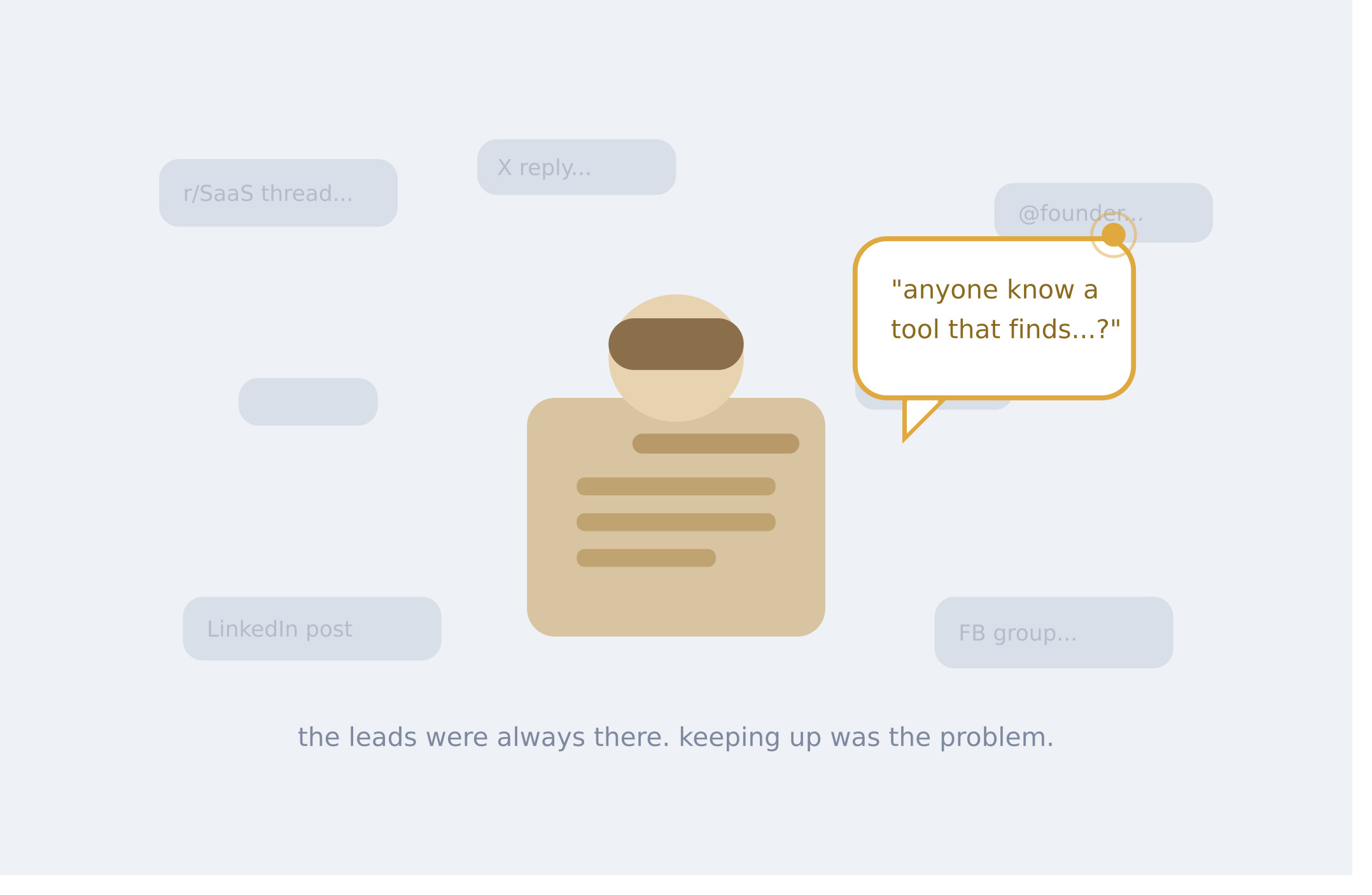
The idea sounds simple. Your buyers are out there on Reddit, X, and LinkedIn, asking questions, complaining about tools they hate, and looking for something better. All you have to do is find those conversations and show up.
In practice, it falls apart fast.
The three things that break
The first problem is volume. There are hundreds of communities where your ideal customer might be talking, and each one moves at its own pace. By the time you have checked a handful of subreddits and a few hashtags, an entire day's worth of new threads has piled up somewhere else.
The second problem is attention. Social platforms are built to pull you in. You open Reddit to do thirty minutes of focused lead research, and somehow you surface an hour later having read about someone's sourdough starter. The tools that hold your buyers are the same tools designed to distract you.
The third problem, and the one most people underestimate, is signal. Most of what looks like a lead is not one. Someone mentioning a product is not the same as someone shopping for an alternative to it. When you search by keyword, you drown in mentions that go nowhere, and the few real opportunities get lost in the pile.
So what actually works?
A few things help. Narrowing your search to a small set of high signal phrases beats casting a wide net. Words like "looking for," "recommend," "alternative to," and "anyone use" tend to mark genuine intent far better than your product category alone. Speed matters too, because a fresh thread where someone is actively asking is worth far more than one that has gone quiet. And consistency beats intensity, since checking a little every day catches more than a marathon session once a week.
The honest takeaway from a year of doing this by hand is that the leads were never the bottleneck. They were always there. The bottleneck was a person trying to be in five places at once, every single day, without missing the moments that mattered.
That realization is exactly why automated social listening exists. The work of scanning, filtering, and scoring conversations is repetitive and time sensitive, which makes it a poor fit for human attention and a good fit for software. The judgment of how to show up in a conversation is still yours. The grind of finding it does not have to be.